


(2025) PASS MB-820 exam with Microsoft MB-820 Real Exam Questions
Real exam questions are provided for Microsoft Dynamics 365 tests, which can make sure you 100% pass
NEW QUESTION # 62
Case Study 1 - Contoso, Ltd
Background
Contoso, Ltd. is a sales company in the manufacturing industry. It has subsidiaries in multiple countries/regions, each with its own localization. The subsidiaries must be data-independent from each other. Contoso. Ltd. uses an external business partner to manage the subcontracting of some manufacturing items. Contoso, Ltd. has different sectors with data security between sectors required.
Current environment
Contoso, Ltd. uses Business Central online as the main ERP for financials, sales, purchase, warehouse, and manufacturing processes. It has employees that use the Business Central web application and external applications. The company has a custom external mobile app under development.
The IT department and its partners installed custom extensions to satisfy the company's requirements where the functionality is not available natively.
Contoso, Ltd. interacts with external services provided by customers and partners. Different applications interact with SOAP and OData endpoints exposed from Business Central.
An external business partner of Contoso, Ltd. exposed a REST API for receiving details about new subcontracting orders and for sending the planned release date of each subcontracting order received.
Contoso, Ltd. has not activated the monitoring of the tenant and has no internal telemetry for its apps.
Custom reporting must be created to meet the requirements of the different departments.
Tenant management
Contoso, Ltd. has the following tenant management considerations:
IT department
The IT department requires the ability to monitor the tenant to prevent performance problems and detect possible anomalies.
The IT department plans to use Azure Application Insights and Log Analytics to inspect the ingested telemetry signals.
All tenant upgrades are automatically handled by Microsoft. The IT department does not check for update availability or for tenant-related notifications.
The IT department has not configured the receipt of tenant-related notifications from the Business Central admin center.
External business partner
The external business partner must add custom telemetry to an application created for Contoso, Ltd. to monitor a business process.
Custom telemetry signals for the application must be visible only on the partner's telemetry.
SOAP
Contoso, Ltd. plans to dismiss using the SOAP protocol for integrations.
Contoso, Ltd. must be able to detect if external applications are using its Business Central SOAP endpoints.
Issue
The Business Central tenant is upgraded by Microsoft to a new major version during the night.
Users report that one of the Contoso, Ltd. extensions disappeared from the tenant. The IT department confirms that the extension is still published.
Custom mobile application requirements
Contoso, Ltd. plans to create a custom mobile application that has the following requirements:
The app must be used by employees to check item details from the ERP in real time and to report issues that occur during the manufacturing process.
An AL extension must be created for handling archived issues.
Business Central development guidelines must be followed when implementing modules.
A module must be implemented for the reporting and tracking of issues information. You plan to call this module Issue Management. The module must expose a method named PostIssue.
Code modifications will be required over time.
The Issue Management process must be split into two extensions:
ISSUE BASE: main extension
ISSUE EXT: second extension with dependency from ISSUE BASE
In the version 1.0.0.0 of the ISSUE BASE extension, you plan to create an Issue table that contains a global Decimal variable named IssueTotal.
In the version 1.0.0.0 of the ISSUE BASE extension, you plan to define a table named Issue Category with a Description field defined as follows:
The Issue table defined in ISSUE BASE extension contains a Clone procedure defined as follows:
In the ISSUE EXT extension, you create a tableextension object of the Issue table.
The tableextension object of the Issue table must access the IssueTotal: Decimal variable.
After weeks of usage, you discover that you must remove the Description field and the Clone procedure because they are no longer required.
In a new version of the ISSUE BASE extension, you create a new Issue Type table. You must move data row by row from a previously obsolete Issue Category table to the new Issue Type table. Because a large amount of data must be moved, you must write an Upgrade codeunit by using the DataTransfer object.
The IT department creates a custom API for exposing the custom Issue table. The API provides an action for copying an issue to a new table. The action is defined as follows:
Contoso, Ltd. must create an API in Business Central to expose item details to the mobile application.
The API must have the lowest possible impact on the production environment when used during working hours.
The API must only support Get operations.
Debugging problems
A user of the ISSUE BASE extension in Business Central reports a problem.
To debug the problem, snapshot debugging with the following configuration was activated:
You discover that the debugging is not triggering.
Integration with business partner for subcontracting
Contoso, Ltd. must connect Business Central to the external API provided by the business partner. This will be used for the partner to send the details of new subcontracting orders to fulfill the sales demand, and for receiving the planned release date of each order sent. The integration requirements are as follows:
The business partner will provide a REST API secured with basic authentication. Credentials to access the API will be shared with Contoso, Ltd.
The API for sending subcontracting orders must be called by sending an authenticated POST request to the given endpoint.
The API for retrieving the order no. and planned release date of each subcontracting order responds with the following JSON:
Each order no. must be retrieved.
Drag and Drop Question
You need to handle the removal of the Description field and the Clone procedure without breaking other extensions.
Which three actions should you perform in sequence? To answer, move the appropriate actions from the list of actions to the answer area and arrange them in the correct order.
NOTE: More than one order of answer choices is correct. You will receive credit for any of the correct orders you select.
Answer:
Explanation:
NEW QUESTION # 63
Hotspot Question
A company is setting up a custom telemetry trace signal to send traces on failed customer statement emails.
For each of the following statements, select Yes if the statement is true. Otherwise, select No.
NOTE: Each correct selection is worth one point.
Answer:
Explanation:
NEW QUESTION # 64
You create a table with fields.
You observe errors in the code
You need to resolve the errors.
For each of the following statements, select Yes if the statement is true. Otherwise, select No.
NOTE: Each correct selection is worth one point.
Answer:
Explanation:
NEW QUESTION # 65
Case Study 2 - Alpine Ski House
Company Background
Alpine Ski House is a company that owns and operates hotels, restaurants, and stores.
Currently, the company uses the following software and interface:
- Property management software (PMS) to manage hotel rooms
- On-premises accounting software to generate sales invoices and create purchase orders
- An API that allows restaurants and stores to obtain necessary information Restaurants and stores use standalone software for point of sale (POS) devices. Each day, the POS terminals generate a text file of sales data and save the files in a server folder. An account assistant must manually import the files to the current software tables to be processed by the system.
The general manager receives several reports monthly from department managers. The reports take too much time to prepare.
Planned improvements
The company is moving from a different system to Business Central online to manage the whole company.
The company plans to increase efficiency in every department by using APIs to obtain or share information between the different systems.
Each department involved in purchasing must be able to make purchase requests automatically and easily. The departments do not need access to the full ERP management system.
Technical specifications
Alpine Ski House requires the development of several extensions for the planned improvements.
Business Central design patterns must be used to develop all extensions.
Alpine Ski House must develop the following pages:
- Pages that provide multiple configurations in a multistep dialog, like a wizard, to provide required information when the extensions are first installed
- Department-specific Role Center pages to show relevant information and pages with additional information The IT department plans to use Power BI to analyze departmental information. The database must be configured to provide optimal performance.
Department-specific requirements
Housekeeping department
The housekeeping department requires the following to increase efficiency and help avoid data entry errors:
- A Housekeeping Role Center to minimize navigation to relevant areas in Business Central online and to show relevant information in it
- Pages to embed into a new Room page to show additional information about the Room entity
- A table named Room Incident for the housekeeping team to enter room issue information
- A Housekeeping canvas app that connects to an extension
- The department requires the development of an extension with a new API page named RoomsAPI.
- The housekeeping team will use RoomsAPI to publish room details, update when work is complete, or provide repair notifications from the canvas app.
- This custom API page must expose a custom table named Rooms and have an ID 50000. The table must be able to update from the PMS. The PMS team must know the endpoint to connect to the custom API.
- A developer provides the following details for the API page:
- The extension must be published in Business Central online and include a list page named Room List that includes all hotel rooms.
- Installation or updates to this extension must meet the following requirements:
o Some web services must be published automatically.
o The version of the specified application's metadata must be obtained in AL language, o The code required to perform tasks cannot be accessible from other parts of the application.
The Room Incident table information must include the following fields:
- Incident entry: An incremental number
- Room No.: A room from the Room table
- Incident Date: The work date
o The table definition in the Room Incident table must autofill the Incident Date when the housekeeping team inserts a new record, o The value for Incident Date must be the work date configured in the Business Central online client.
- Status: Includes the following options to identify the status of the incident:
o Open: When the Room Incident is created
o In Progress: When someone starts repair work
o Closed: When the incident is solved
- Incident Closing Date: Auto-updating field (when the status passes to Closed, the field will update with the work date)
- Incident Description: Text
- Image: Media data type
o The stored picture must be downloadable from a menu action,
o A Room Incident page must be developed to contain the download action.
Department-specific requirements
Restaurants and stores
- To increase efficiency, the new system must manage the generated data from the restaurants and stores directly by using the API on the POS terminals.
- The company requires a codeunit called from a job queue to read the information from the POS terminal APIs.
- The POS terminal information must be stored in a table named POS Information, have an ID
50100, and be editable on a page.
- The account manager requires an option on the menu of the page to run the process manually.
- To analyze the information received from the POS terminals, the company requires:
- A custom API named ticketAPI to export the information to Power BI
- Use of the Read Scale-Out feature to improve database performance
Department-specific requirements
Purchasing department and non-conformity handling
The purchasing department requires a new entity in Business Central online to log non- conformities of goods received from vendors. The entity must be set up as follows:
- The non-conformity entity must have two tables:
o a header with common information
o one or more lines with the detailed received items that are non-conforming
- The entity requires a page named Non-conformity and a subpage named Non-conformity Lines to store the information.
When a purchase order with incorrect quantity or quality issues is received, the entity must create a non-conformity document in the system. The following information must be included in the document:
o Non-conformity Number: must use the No. Series table from Business Central online to manage this field and use these features:
o Alphanumeric values
o Number format that includes "NC" and the year as part of the number; for example, NC24-001
- Non-conformity Date: stores only the creation date
- Vendor No.: stores the number of the vendor that sent the items; only vendors from the company must be included
- Owner: code of an employee defined in the company
- Receipt No.: must meet the following conditions:
o Be an existing receipt No.
o Be received from the vendor indicated in the Vendor No. field
- Comments: can include comments with rich text and pictures to illustrate quality problems
- Status: includes non-conformity statuses, such as:
o Open
o Notified
o Closed
- Lines must contain the following details:
o Item No.: item received (for existing inventory items only)
o Description: item description
o Quantity: non-conforming quantity
- Non-conformity Type:
o Quality
o Quantity
o Delivery date
The serial numbers of the non-conformities and the period in which they can be created must be in a configuration table and its corresponding page to allow them to be modified for the users.
Hotspot Question
You need to select the appropriate page types to solve the reporting requirements.
Which page types should you use? To answer, select the appropriate options in the answer area.
NOTE: Each correct selection is worth one point.
Answer:
Explanation:
NEW QUESTION # 66
A company owns and operates hotels, restaurants, and stores.
When the staff orders materials from the purchasing department, the requests are not directed to the correct approvers.
The staff requires a new field named Approver from which they can select the appropriate approver. The field must include the following options:
* Hotel manager
* Restaurant manager
* Store manager
* Purchasing manager
You need to create the Approver field in the Item table by using an AL extension.
Which three actions should you perform in sequence? To answer, move the appropriate actions from the list of actions to the answer area and arrange them in the correct order.
Answer:
Explanation:
Explanation:
To create the Approver field in the Item table using an AL extension, perform the following actions in sequence:
* Create an enum object named Approver and include all options.
* Create a table extension object for an Item table with an Approver field of enum type named Approver in the fields section.
* Create a page extension object that extends the Item Card object. Add the field to the fields section.
Build and extend tables:To add a new field to an existing table in Business Central using AL extension, you need to define an enumeration (enum) with the possible values for the new field. Then, you create a table extension object where you add the new field and specify its type as the enum you created. This adds the field to the Item table. Finally, you modify the user interface to display the new field by creating a page extension for the Item Card page and adding the new field to it.
NEW QUESTION # 67
You have a per tenant extension that contains the following code.
For each of the following statements, select Yes if the statement is true. Otherwise, select No.
NOTE: Each correct selection is worth one point.
Answer:
Explanation:
NEW QUESTION # 68
You need to configure telemetry for the SaaS tenant and test whether the ingested signals are displayed.
Which three actions should you perform in sequence? To answer, move the appropriate actions from the list of actions to the answer area and arrange them in the correct order.
Answer:
Explanation:
Explanation:
The correct sequence of actions to configure telemetry for the SaaS tenant and test whether the ingested signals are displayed would be:
* Create an Azure Application Insights instance by using the Azure Portal in the Customer's subscription.
* Select the environment in the Admin Center and place the connection string in the Application Insights Connection String field.
* Select the Application Insights instance, select Logs and then inspect the Traces table.
To set up telemetry for a SaaS tenant using Azure Application Insights, you need to follow these steps:
* Create an Azure Application Insights instance: This is the first step where you create an instance in Azure that will collect the telemetry data. This should be done in the customer's Azure subscription because it's their data that you're monitoring.
* Configure the SaaS tenant to use the created Application Insights instance: This involves entering the correct connection string in the Business Central Admin Center so that telemetry data from the tenant is sent to the Application Insights instance.
* Verify that telemetry is being collected: After configuring, you would check if the telemetry is arriving as expected by inspecting the Traces table in the Azure Application Insights instance. The 'Traces' table holds the telemetry data, which you can query to verify that the correct signals are being ingested.
NEW QUESTION # 69
You need to define the tables used for the non-conformity entity.
What should you use?
- A. document history table to introduce the non-conformity entities
- B. supplemental table to introduce the non-conformity lines
- C. document table to introduce the non-conformity entities
Answer: C
Explanation:
* Table Structure in Business Central: When creating entities such as "non-conformity" entities in Business Central, you use document tables to represent entities that have a header and line structure. In this case, the non-conformity entity has:
* A header with common information (Non-conformity Number, Date, Vendor No., etc.).
* One or more lines representing the detailed information for each non-conforming item.
* Document Table Usage:
* Document Table: A document table is the correct table type for scenarios where you have a header (with general information like vendor details) and lines (with detailed, item-specific information).
* Document tables are typically used for entities such as Sales Orders, Purchase Orders, or any other transactional data where you have both header and line information.
* Supplemental Table (Option C):
* Supplemental tables are usually used to add supplementary information to existing data in Business Central. In this case, we need to store detailed line information, which is a core part of the entity rather than supplementary data, so a supplemental table would not be appropriate here.
* Document History Table (Option A):
* Document history tables are used to track changes and historical data for entities but are not suitable for the main introduction of the entity and its lines. This option is also not appropriate.
Reference Documentation:
* Introduction to Business Central Tables
* Document Tables in Business Central
NEW QUESTION # 70
You need to create the Install codeunit that is requited in the extension used for installing or updating the Housekeeping app.
Which data type or declaration should you use? To answer, select the appropriate options in the answer area.
NOTE; Each correct selection is worth one point.
Answer:
Explanation:
NEW QUESTION # 71
You need to write the code to call the subcontractor's REST API.
How should you complete the code segment? To answer, select the appropriate options in the answer area.
NOTE: Each correct selection is worth one point.
Answer:
Explanation:
NEW QUESTION # 72
You plan to run a debug for a client.
You extend the Standard Sales - Invoice report to add a new requirement.
You create a Report Extension 'Ext Standard Sales - Invoice' with ID = 50100 and add the following lines of code. (Line numbers are included for reference only.)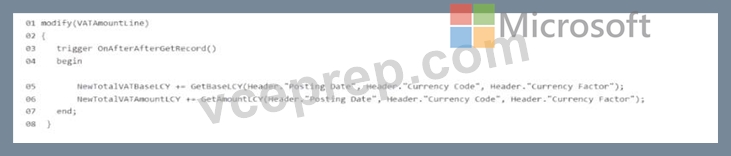
The client informs you that the value of the New Total VATBaseLCY column is incorrect.
You need to run a debug to identify the cause.
Which four actions should you perform in sequence? To answer, move the appropriate actions from the list of actions to the answer area and arrange them in the correct order.
Answer:
Explanation:
Explanation:
Here's the process to follow in the correct sequence:
* In Visual Studio Code, locate the Ext Standard Sales - Invoice report extension from your application.
* The first step is to locate the specific extension you're working with so you can modify or inspect its code.
* Search where the NewTotalVATBaseLCY variable is being calculated and set a breakpoint on the line.
* To debug the issue, you need to place a breakpoint on the line where the NewTotalVATBaseLCY is calculated.
* Start debugging.
* Once the breakpoint is set, you begin the debugging process to examine the values and code execution.
* Use the step-over functionality.
* After starting the debugging, you will use the step-over functionality to move through the code line by line and observe the values of the variables.
NEW QUESTION # 73
A company plans to import and export data with Business Central
You must configure an XMLport that provides the following implementation;
* Specifies import 01 export on the Request page at run time
* Formats the data in a non-fixed length CSV format
You need to create the XMLport.
How should you complete the code segment' To answer, select the appropriate options in the answer area.
NOTE: Each correct selection is worth one point.
Answer:
Explanation:
Explanation:
Direction: Both
Format: VariableText
You are configuring an XMLport for Business Central with the following requirements:
* Specifies import or export on the Request page at runtime.
* Formats the data in a non-fixed length CSV format.
XMLport Configuration:
* Specifies import or export on the Request page at runtime.The Direction property must be set to Both.
* This allows the XMLport to both import and export data depending on user selection during runtime.
* Formats the data in a non-fixed length CSV format.The Format property must be set to VariableText.
* VariableText is used for delimited text formats like CSV, which do not have a fixed length for fields.
NEW QUESTION # 74
A company plans to change a field on the Resource Card page in a Base Application.
You need to hide the field "Unit Price" from the Resource Card page.
Which code snippet should you use?
- A.

- B.

- C.

- D.

Answer: D
Explanation:
To hide the field "Unit Price" from the Resource Card page in Microsoft Dynamics 365 Business Central, you need to modify the visibility property of the field using the modify keyword, which allows you to change the properties of an existing field on a page.
* modify("Unit Price") is the correct way to target an existing field on a page (like the Resource Card page).
* The line Visible = false; makes the field invisible on the page.
Here's a breakdown of why each option is right or wrong:
* Option A:
* Uses addlast("Unit Price"), which is incorrect because you are not adding a new field; you're modifying an existing one. Also, Visible = false is correct for hiding a field, but the wrong method (addlast) is used.
* Option B:
* Uses modify("Unit Price") with Enabled = false;. This would disable the field (make it non- editable), not hide it. The field would still be visible, so this does not meet the requirement.
* Option C:
* Uses addlast("Unit Price"), which is incorrect, and Enabled = false;, which would disable the field, not hide it.
* Option D:
* modify("Unit Price") { Visible = false; } is the correct syntax for hiding the field on the page.
Correct Code Snippet:
modify("Unit Price")
{
Visible = false;
}
This hides the "Unit Price" field from the Resource Card page.
NEW QUESTION # 75
A company uses Business Central.
The company has sales orders that have a different location in the header than in the customer's card. You plan to add a check on sales order posting.
The check must meet the following requirements.
* Sales Order must have the same Location Code as the Location Code set up on the customer's card.
* Must not be run in preview mode.
* Must be run even if the user is only shipping items and not invoicing.
You create an event subscription for codeunit 80 "Sales-Post" You need to identify which event to subscribe to Which event should you identify?
- A.

- B.

- C.

- D.

Answer: C
Explanation:
* This event occurs before posting a sales document.
* PreviewMode is available in the parameters, which allows checking whether the process is being run in preview mode.
* This event is typically used for sales order posting and can be used for both shipping and invoicing.
This event matches the requirements because:
* You can check if PreviewMode is false.
* It can run for both shipping and invoicing.
NEW QUESTION # 76
You plan to create a table to hold client data.
You have the following data integrity requirements:
* Lookups into other records must be established.
* Validate if a record exists in a destination record.
You need to select the table field property to use for each requirement.
Which table field property should you use? To answer, select the appropriate options in the answer area.
NOTE: Each correct selection is worth one point.
Answer:
Explanation:
Explanation:
For the data integrity requirements, the table field properties to use are:
* To establish lookups into other records, use the TableRelation property.
* To validate if a record exists in a destination record, use the ValidateTableRelation property.
In Business Central, when creating tables to hold data, maintaining data integrity is crucial:
* TableRelation Property:This property is used to create a relationship between the field in one table and a field in another table, which is typically used for lookups. When you set the TableRelation property on a field, it allows users to select from a list of values that exist in the related table.
* ValidateTableRelation Property:This property is used to ensure that the value entered in a field matches one of the values in a related table. If a user tries to enter a value that doesn't exist in the related table, an error will occur.
NEW QUESTION # 77
You need to create the API page according to the requirements.
How should you complete the code segment? To answer, select the appropriate options in the answer area.
NOTE: Each correct selection is worth one point.
Answer:
Explanation:
NEW QUESTION # 78
You create an 'AddltemsToJson" procedure and publish it.
The procedure fails to run.
You need to fix the errors in the code.
For each of the following statements, select Yes if the statement is true. Otherwise, select No.
Answer:
Explanation: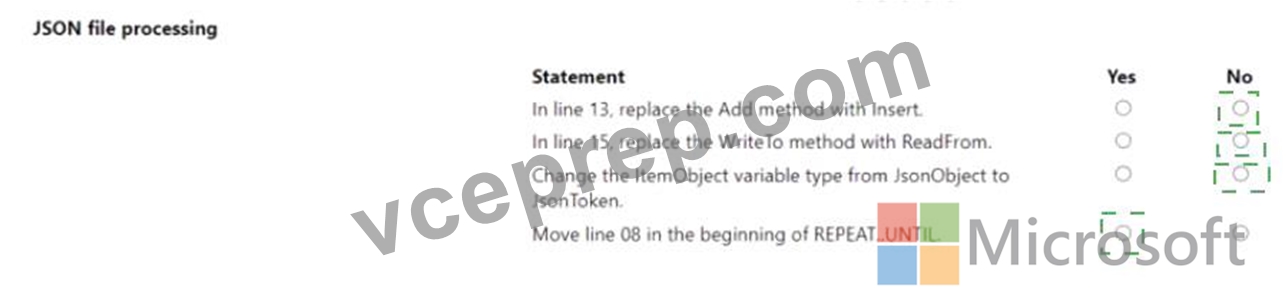
Explanation:
* In line 13, replace the Add method with Insert. = NO
* In line 15, replace the WriteTo method with ReadFrom. = NO
* Change the ItemObject variable type from JsonObject to JsonToken. = NO
* Move line 08 in the beginning of REPEAT .. UNTIL. = YES
The provided code is intended to serialize a list of items from the Item table into a JSON array format. Here is a breakdown of the code and the necessary corrections:
* In line 13, "ItemsArray.Add(ItemObject)": This line is correctly using the Add method to add the ItemObject to the ItemsArray. The Add method is the correct method to use for adding items to a JsonArray. Therefore, there is no need to replace Add with Insert.
* In line 15, "ItemsArray.WriteTo(RequestText)": The WriteTo method is used correctly to serialize the ItemsArray into a JSON formatted string and store it in the RequestText variable. The ReadFrom method is used for the opposite operation, i.e., to deserialize a JSON formatted string into a JsonArray, which is not the goal in this context. Hence, no change is needed here.
* Change the ItemObject variable type from JsonObject to JsonToken: The ItemObject variable is intended to hold JSON objects representing individual items, making JsonObject the appropriate type.
JsonToken is not a type used in this context within AL for Business Central, and thus the variable type should remain as JsonObject.
* Move line 08, "Clear(ItemObject)": This line should be moved inside the repeat loop to ensure that the ItemObject is cleared for each item in the loop. Placing it before the repeat would only clear it once before the loop starts, which could lead to incorrect serialization as the previous item's properties would not be cleared from the ItemObject.
The logic for serializing records into JSON is a common operation when interfacing with APIs or web services in Business Central, and the pattern shown in the code is typical for such operations.
NEW QUESTION # 79
A company uses Business Central.
The company has sales orders that have a different location in the header than in the customer's card. You plan to add a check on sales order posting.
The check must meet the following requirements.
* Sales Order must have the same Location Code as the Location Code set up on the customer's card.
* Must not be run in preview mode.
* Must be run even if the user is only shipping items and not invoicing.
You create an event subscription for codeunit 80 "Sales-Post" You need to identify which event to subscribe to Which event should you identify?
- A.

- B.

- C.

- D.

Answer: B
Explanation:
* This event occurs before posting a sales document.
* PreviewMode is available in the parameters, which allows checking whether the process is being run in preview mode.
* This event is typically used for sales order posting and can be used for both shipping and invoicing.
This event matches the requirements because:
* You can check if PreviewMode is false.
* It can run for both shipping and invoicing.
NEW QUESTION # 80
A company plans to change a field on the Resource Card page in a Base Application.
You need to hide the field "Unit Price" from the Resource Card page.
Which code snippet should you use?
- A.

- B.

- C.

- D.

Answer: D
Explanation:
To hide the field "Unit Price" from the Resource Card page in Microsoft Dynamics 365 Business Central, you need to modify the visibility property of the field using the modify keyword, which allows you to change the properties of an existing field on a page.
* modify("Unit Price") is the correct way to target an existing field on a page (like the Resource Card page).
* The line Visible = false; makes the field invisible on the page.
Here's a breakdown of why each option is right or wrong:
* Option A:
* Uses addlast("Unit Price"), which is incorrect because you are not adding a new field; you're modifying an existing one. Also, Visible = false is correct for hiding a field, but the wrong method (addlast) is used.
* Option B:
* Uses modify("Unit Price") with Enabled = false;. This would disable the field (make it non- editable), not hide it. The field would still be visible, so this does not meet the requirement.
* Option C:
* Uses addlast("Unit Price"), which is incorrect, and Enabled = false;, which would disable the field, not hide it.
* Option D:
* modify("Unit Price") { Visible = false; } is the correct syntax for hiding the field on the page.
Correct Code Snippet:
modify("Unit Price")
{
Visible = false;
}
This hides the "Unit Price" field from the Resource Card page.
NEW QUESTION # 81
A company has a test application.
A user observes the following error messages when running the test:
* "Unhandled Ul: Message'
* "Unhandled Ul: Confirm"
You need to resolve the errors. Which action should you take?
- A. Create a separate test codeunit that has Message Handler and Confirm Handler methods.
- B. Create the Message Handler and Confirm Handler methods in the test runner codeunit.
- C. Create the Message Handler and Confirm Handler methods in the test codeunit.
- D. Create a separate test runner codeunit that has Message Handler and Confirm Handler methods.
Answer: B
Explanation:
A user observes error messages such as:
* "Unhandled UI: Message"
* "Unhandled UI: Confirm"
These messages indicate that the test code is not handling system prompts like Message and Confirm dialogs, which can appear during test execution.
Options Explanation:
* Message Handler and Confirm Handler methods are used to intercept and handle these UI prompts during automated testing.
* These methods should be added to the test runner codeunit, which is responsible for running the tests and handling these system-level interactions.
NEW QUESTION # 82
A company is deploying Business Central on-premises.
The company plans to use a single-tenant deployment architecture.
You need to describe how the data is stored and how the Business Central Server is configured.
In which two ways should you describe the single-tenant architecture? Each correct answer presents a complete solution.
NOTE: Each correct selection is worth one point.
- A. The application and the business data are stored in the same database.
- B. The application and business data are stored in separate databases.
- C. Multiple customers share a single Business Central Server.
- D. Each customer has their own Business Central Server.
- E. Multiple customers share multiple Business Central Server instances.
Answer: A,B
Explanation:
In a single-tenant deployment architecture of Business Central on-premises, the following characteristics describe how the data is stored and how the Business Central Server is configured:
The application and the business data are stored in the same database (B): In a single-tenant architecture, each tenant (which typically corresponds to a single customer) has its own dedicated database. This database contains both the application objects (such as pages, reports, codeunits, etc.) and the business data (such as customer, vendor, and transaction records). This setup ensures that each tenant's data is isolated and can be managed independently.
The application and business data are stored in separate databases (D): While (B) is a characteristic of a single-tenant deployment, it's important to clarify that in some configurations, the application objects can be stored in a separate database from the business data. This approach can be used for easier maintenance and upgrades of the application code without affecting the business data. However, each tenant still has its own set of databases, maintaining the single-tenancy model.
The other options provided do not accurately describe a single-tenant architecture:
Each customer has their own Business Central Server (A): This statement might be misleading. In a single-tenant deployment, while each customer has their own database, they do not necessarily have their own Business Central Server instance. Multiple databases (tenants) can be hosted on a single server instance, although they are not shared across customers.
Multiple customers share a single Business Central Server (C) and Multiple customers share multiple Business Central Server instances (E): These options describe a multi-tenant architecture rather than a single-tenant one. In a multi-tenant setup, multiple customers (tenants) can share the same server instance and even the same application database, with data isolation ensured at the application level.
NEW QUESTION # 83
You need to access the RoomsAPI API from the canvas app.
What should you do?
- A. Include in the extension a codeunit of type Install that publishes RoomsAPI.
- B. Use the default API configuration in Business Central
- C. Enable the APIs for the Business Central online environment.
- D. Open the Web Services page and publish the RoomsAPI page as a web service.
Answer: A
Explanation:
* API Publishing for Extensions:
* In Business Central, when creating custom APIs like RoomsAPI, it is important to ensure that they are automatically published during the installation or upgrade of the extension.
* To achieve this, you can include a codeunit of type Install in the extension that explicitly publishes the custom API (RoomsAPI) as a web service. This ensures that it is available for use immediately after the extension is deployed without requiring manual intervention.
* Codeunit Type:
* A codeunit of type Install runs when the extension is installed or upgraded. This type of codeunit can be used to perform setup tasks such as publishing web services or APIs like RoomsAPI.
* Why Not Other Options?
* Option A (default API configuration): This would not automatically publish the RoomsAPI.
Default APIs do not cover custom APIs.
* Option B (enable APIs for the environment): Enabling APIs in Business Central allows the standard APIs to be used, but custom APIs still need to be manually published.
* Option C (publish via Web Services page): This would work but requires manual intervention to publish RoomsAPI, which does not fulfill the requirement of automatic publishing during installation.
Reference Documentation:
* Publishing APIs in Extensions
* Codeunit Types in Business Central
NEW QUESTION # 84
Drag and Drop Question
You create the following Vendor table and Item table in Business Central.
Vendor:
Item:
You require the following data set to assign vendors to items.
You need to create a query to assign the vendors.
Which three code blocks should you use to develop the solution? To answer, move the appropriate code blocks from the list of code blocks to the answer area and arrange them in the correct order.
NOTE: More than one order of answer choices is correct. You will receive credit for any of the correct orders you select.
Answer:
Explanation:
Explanation:
To create a query that assigns vendors to items in Business Central, use the following code blocks in sequence:
dataitem(Vendor; Vendor)
dataitem(Item; Item)
DataItemLink = "Vendor No." = Item.Vendor_No;
Creating a query:
In Business Central, a query object is used to combine data from multiple tables. You start by specifying each table as a data item. In this case, you would start with the Vendor table and then the Item table. After specifying the data items, you need to link them together. The DataItemLink property is used to establish a relationship between two data items based on a common field.
Here, you are linking the Vendor and Item tables on the "Vendor No." field, which is present in both tables. This link ensures that the query will return a dataset that includes related records from both tables based on the vendor number. The order of the code blocks ensures the logical flow and relationships between tables as required for the query.
NEW QUESTION # 85
A company is examining Connect apps and Add-on apps for use with Business Central.
You need to describe the development language requirements for Connect apps and Add-on apps.
How should you describe the app language requirements? To answer, move the appropriate app types to the correct descriptions. You may use each app type once, more than once, or not at all. You may need to move the split bar between panes or scroll to view content.
NOTE: Each correct selection is worth one point.
Answer:
Explanation:
Explanation:
* Developed by using any coding language: Connect app
* Developed by using AL language in Visual Studio Code: Add-on app
In Microsoft Dynamics 365 Business Central, there are distinct types of applications that can be developed:
Connect apps and Add-on apps. Each has its own development language requirements:
* Connect apps:
* Connect apps are designed to connect Business Central with external services or applications.
They are often developed using a variety of programming languages, not limited to the AL language, and can be hosted outside of the Business Central environment. Therefore, when a description states that the app is developed using any coding language, it generally refers to a Connect app. This type of app integrates with Business Central through APIs and web services.
* Add-on apps:
* Add-on apps are built to extend the functionality of Business Central within the application itself.
These are developed using the AL language, which is the programming language for Business Central, and they are created and managed within the Visual Studio Code environment with the AL Language extension. An Add-on app is typically a Business Central extension that is directly installed into the Business Central environment.
The language and environment used for developing these apps are key differentiators between Connect apps and Add-on apps.
NEW QUESTION # 86
A company uses Business Central.
The company plans to use a translation file in an extension. The extension has a caption that should not be translated.
You need to prevent the caption from being translated.
What should you do?
- A. Use the CaptionML property and copy the same caption for each language used.
- B. Delete the Caption property.
- C. Set the GenerateLockedTranslations feature in the appjson file.
- D. Add the Locked = true parameter to the Caption.
- E. Copy the same caption for each language in the translation file.
Answer: D
Explanation:
To prevent a caption from being translated in an extension for Microsoft Dynamics 365 Business Central, you should add the Locked = true parameter to the Caption (C). This parameter explicitly marks the caption as locked for translation, ensuring that it remains unchanged across different language versions of the extension.
This approach is useful for specific terms, brand names, or other elements within the application that should remain consistent regardless of the user's language settings. Unlike the other options, which involve manual manipulation of the translation file or properties, setting Locked = true directly in the AL code provides a clear, maintainable, and error-proof method to exclude specific captions from the translation process.
Topic 1, Case Study Alpine Ski House
Alpine Ski House is a company that owns and operates hotels, restaurants, and stores. Currently, the company uses the following software and interlace:
* Property management software (PMS) to manage hotel rooms
* On-premises accounting software to generate sales invoices and create purchase orders
* An API that allows restaurants and stores to obtain necessary information Restaurants and stores use standalone software for point of sale (POS) devices. Each day, the POS terminals generate a text file of sales data and save the files in a serval folder. An account assistant must manually import the files to the current software tables to be processed by the system.
The general manager receives several reports monthly from department managers. The reports take too much time to prepare.
The company is moving from a different system to Business Central online to manage the whole company.
The company plans to increase efficiency in every department by using APIs to obtain or share information between the different systems.
Each department involved in purchasing must be able to make purchase requests automatically and easily.
The departments do not need access to the full ERP management system.
Alpine Ski House requires the development of several extensions for the planned improvements. Business Central design patterns must be used to develop all extensions.
Alpine Ski House must develop the following pages:
* Pages that provide multiple configurations in a multistep dialog, like a wizard, to provide required information when the extensions are first installed
* Department-specific Role Center pages to show relevant information and pages with additional information The IT department plans to use Power 61 to analyze departmental information. The database must be configured to provide optimal performance.
The housekeeping department requires the following to increase efficiency and help avoid data entry errors:
* A Housekeeping Role Center to minimize navigation to relevant areas In Business Central online and to show relevant information in it
* Pages to embed into a new Room page to show additional information about the Room entity
* A table named Room Incident for the housekeeping team to enter room issue information
* A Housekeeping canvas app that connects to an extension
The department requires the development of an extension with a new API page named RoomsAPI.
* The housekeeping team will use RoomsAPI to publish room details, update when work is complete, or provide repair notifications from the canvas app.
* This custom API page must expose a custom table named Rooms and have an ID 50000. The table must be able to update from the PMS. The PMS team must know the end to connect to the custom API.
* A developer provides the following details for the API page:
APIPublisher = 'alpine';
APIGroup - 'integration';
APIVersion - 'v2.6';
fntityName # 'room';
EntitySetName = 'rooms';
* The extension must be published in Business Central online and include a list page named Room List that includes all hotel rooms.
* Installation or updates to this extension must meet the following requirements:
o Some web services must be published automatically.
o The version of the specified application's metadata must be obtained in AL language.
o The code required to perform tasks cannot be accessible from other parts of the application.
The Room Incident table information must include the following fields:
* Incident entry: An incremental number
* Room No.: A room from the Room table
* Incident Date: The work date
o The table definition in the Room Incident table must autofill the Incident Date when the housekeeping team inserts a new record, o The value for Incident Date must be the work date configured in the Business Central online client.
* Status: Includes the following options lo identify the status of the incident:
o Open: When the Room Incident is created
o In Progress: When someone starts repair work
o Closed: When the incident is solved
* Incident Closing Date: Auto-updating field (when the status passes to Closed, the field will update with the work date)
* Incident Description: Text
* Image. Media data type
o The stored picture must be downloadable from a menu action.
o A Room Incident page must be developed to contain the download action.
To increase efficiency, the new system must manage the generated data from the restaurants and stores directly by using the API on the POS terminals.
* The company requires a code unit called from a job queue to read the information from the POS terminal APIs.
* The POS terminal information must be stored in a table named POS Information, have an ID 50100. and be editable on a page.
* The account manager requires an option on the menu of the page to run the process manually.
To analyze the information received from the POS terminals, the company requires:
* A custom API named ticketAPI to export the information to Power BI
* Use of the Read Scale-Out feature to improve database performance
The purchasing department requites a new entity in Business Central online to log non-conformities of goods received from vendors. The entity must be set up as follows:
* The non-conformity entity must have two tables:
o a header with common information
o one or more lines with the detailed received items that are non-conforming
* The entity requires a page named Non-conformity and a subpage named Non-Conformity Lines to store the information.
When a purchase order with incorrect quantity 01 quality issues is received, the entity must create a non- conformity document in the system. The following information must be nick the document:
* Non-conformity Number: must use the No. Series table from Business Central online to manage this field and use these features:
o Alphanumeric values
o Number format that includes "NO and the year as part of the number: for example, NC24-001
* Non-conformity Date: stores only the creation date
* Vendor No.: stores the number of the vendor that sent the items; only vendors from the company must be included
* Owner: code of an employee defined in the company
* Receipt No.: must meet the following conditions:
o Be an existing receipt No.
o Be received from the vendor indicated in the Vendor No. field
* Comments: can include comments with rich text and pictures to illustrate quality problems
* Status: includes nonconformity statuses, such as:
o Open
o Notified
o Closed
* Lines must contain the following details:
o Item No.: item received (for existing inventory items only)
o Description: item description
0 Quantity: non-conforming quantity
0 Non-conformity Type:
# Quality
# Quantity
# Delivery date
The serial numbers of the non-conformities and the period in which they can be created must be in a configuration table and its corresponding page to allow them to be modified for the users.
NEW QUESTION # 87
......
Latest MB-820 Pass Guaranteed Exam Dumps Certification Sample Questions: https://testking.vceprep.com/MB-820-latest-vce-prep.html