


Pass Oracle 1z0-062 Exam With Practice Test Questions Dumps Bundle
2021 Valid 1z0-062 test answers & Oracle Exam PDF
Oracle 1Z0-062 Dumps
Oracle 12c Dumps are tests created to demonstrate all the features of our Oracle 12c Questions Web Simulator. You will be able to access to many questions and will have the ability to test your knowledge on-line.
There are several components you can interact with when you take our practice tests:
- Start now our 1Z0-062 dumps on-line Simulator.
- Mark the Oracle 12c Certification Questions you wish to review later. All the questions you have marked will be listed in the right section “marked questions”. You will be able to jump directly to the question from this list.
- Keep an eye on the countdown. This will tell you how much time is left. When the countdown expires, the test will be automatically submitted.
- Navigate the Oracle 12c Questions using the “Previous” and “Next” buttons.
- Once the test is submitted, the result section will expand. Here, you will be able to review all the questions of the test. From here, you can also navigate directly to each question.
- if you want to take a look at the correct answers for a question, just click the “Solution” button. In the solution section you will be able to check your answers as well as find a full explanation.
Oracle 1z0-062 Exam Syllabus Topics:
| Topic | Details |
|---|---|
| Topic 1 |
|
| Topic 2 |
|
| Topic 3 |
|
| Topic 4 |
|
| Topic 5 |
|
| Topic 6 |
|
| Topic 7 |
|
NEW QUESTION 164
Which two statements are true when row archival management is enabled?
- A. The ORA_ARCHIVE_STATE column is visible if referenced in the select list of a query.
- B. The ORA_ARCHIVE_STATE column visibility is controlled by the ROW ARCHIVAL VISIBILITY session parameter.
- C. The ORA_ARCHIVE_STATE column is updated manually or by a program that could reference activity tracking columns, to indicate that a row is no longer considered active.
- D. The ROW ARCHIVAL VISIBILITY session parameter defaults to active rows only.
- E. The ORA_ARCHIVE_STATE column is updated automatically by the Oracle Server based on activity tracking columns, to Indicate that a row is no longer considered active.
Answer: B,C
Explanation:
A: Below we see a case where we set the row archival visibility parameter to "all"
thereby allowing us to see all of the rows that have been logically deleted:
alter session set row archival visibility = all;
We can then turn-on row invisibility back on by changing row archival visibility = "active":
alter session set row archival visibility = all;
B: To use ora_archive_state as an alternative to deleting rows, you need the following settings and parameters:
1.Create the table with the row archival clause
create table mytab (col1 number, col2 char(200)) row archival;
2.Now that the table is marked as row archival, you have two methods for removing rows, a permanent solution with the standard delete DML, plus the new syntax where you set ora_archive_state to a non-zero value:
update mytab set ora_archive_state=2 where col2='FRED';
3.To make "invisible rows" visible again, you simply set the rows ora_archive_state to zero:
update mytab set ora_archive_state=0 where col2='FRED';
Note:
* Starting in Oracle 12c, Oracle provides a new feature that allow you to "logically delete" a row in a table without physically removing the row. This effectively makes deleted rows "invisible" to all SQL and DML, but they can be revealed at any time, providing a sort of "instant" rollback method.
To use ora_archive_state as an alternative to deleting rows.
NEW QUESTION 165
Which four operations performed after the Oracle Restart installation are automatically added to the Oracle Restart
configuration?
- A. database service created by using SRVCTL
- B. database created by using a SQL statement
- C. database service created by using DBMS_SERVICE.CREATE_SERVICE
- D. database created by using DBCA
- E. ASM instance created by using ASMCA
- F. database service created by modifying the SERVICE_NAMES initialization parameter
- G. listener configured by using NETCA
Answer: A,B,D,G
NEW QUESTION 166
You plan to migrate your database from a File system to Automata Storage Management (ASM) on same platform.
Which two methods or commands would you use to accomplish this task? (Choose two.)
- A. DBMS_FILE_TRANSFER with transportable tablespace
- B. RMAN CONVERT command
- C. Data Pump Export and import
- D. Conventional Export and Import
- E. The BACKUP AS COPY DATABASE . . . command of RMAN
Answer: B,E
Explanation:
Explanation
A:
1. Get the list of all datafiles.
Note: RMAN Backup of ASM Storage
There is often a need to move the files from the file system to the ASM storage and vice versa. This may come in handy when one of the file systems is corrupted by some means and then the file may need to be moved to the other file system.
D: Migrating a Database into ASM
* To take advantage of Automatic Storage Management with an existing database you must migrate that database into ASM. This migration is performed using Recovery Manager (RMAN) even if you are not using RMAN for your primary backup and recovery strategy.
* Example:
Back up your database files as copies to the ASM disk group.
BACKUP AS COPY INCREMENTAL LEVEL 0 DATABASE
FORMAT '+DISK' TAG 'ORA_ASM_MIGRATION';
References:
NEW QUESTION 167
You have the following entry in the tnsnames.ors of your hq.us.example.com host machine: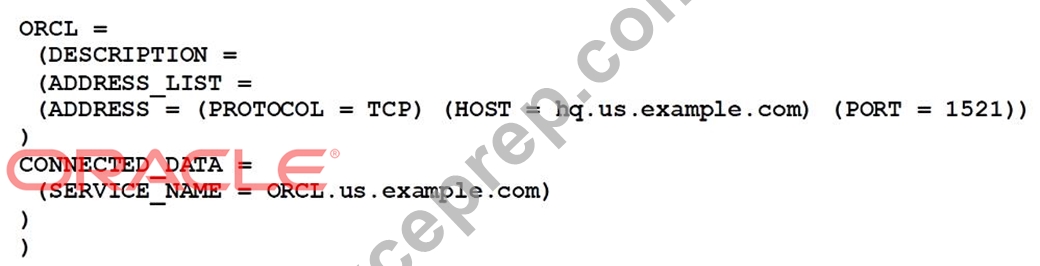
You issue the following command at the command prompt:
Sqlplus HR/HR@ORCL
Which statement is true about the connection to the ORCL database instance?
- A. The connection succeeds, provided the NAMES.DEFAULT_DOMAIN parameter is set to us.example.com in the sqlnet.ora file on the client side.
- B. The connection succeeds, provided the SERVICE_NAMES initialization parameter is set to ORCL.
- C. The connection fails because the net service name does not have the suffix us.example.com.
- D. The connection succeeds, provided the ORCL.us.example.com database service is registered with a listener, the listener is up, and the database is open.
Answer: D
NEW QUESTION 168
You use a recovery catalog for maintaining your database backups.
You execute the following command:
$rman TARGET / CATALOG rman / cat@catdb
RMAN > BACKUP VALIDATE DATABASE ARCHIVELOG ALL;
Which two statements are true? (Choose two.)
- A. Checks are performed to confirm whether all database files exist in correct locations
- B. Backup sets containing both data files and archive logs are created.
- C. Checks are performed for physical corruptions.
- D. Corrupted blocks, if any, are repaired.
- E. Checks are performed for logical corruptions.
Answer: A,C
Explanation:
B (not C): You can validate that all database files and archived redo logs can be backed up by running a command as follows:
RMAN> BACKUP VALIDATE DATABASE ARCHIVELOG ALL;
This form of the command would check for physical corruption. To check for logical corruption, RMAN> BACKUP VALIDATE CHECK LOGICAL DATABASE ARCHIVELOG ALL;
D: You can use the VALIDATE keyword of the BACKUP command to do the following:
Check datafiles for physical and logical corruption
Confirm that all database files exist and are in the correct locations.
Note:
You can use the VALIDATE option of the BACKUP command to verify that database files exist and are in the correct locations (D), and have no physical or logical corruptions that would prevent RMAN from creating backups of them. When performing a BACKUP...VALIDATE, RMAN reads the files to be backed up in their entirety, as it would during a real backup. It does not, however, actually produce any backup sets or image copies (Not A, not E).
NEW QUESTION 169
Identify three benefits of Unified Auditing.
- A. It guarantees zero-loss auditing.
- B. It improves overall auditing performance.
- C. The audit trail cannot be easily modified because it is read-only.
- D. Decreased use of storage to store audit trail rows in the database.
- E. It automatically audits Recovery Manager (RMAN) events.
Answer: B,D,E
Explanation:
Explanation/Reference:
Explanation:
A: Starting with 12c, Oracle has unified all of the auditing types into one single unit called Unified auditing.
You don’t have to turn on or off all of the different auidting types individually and as a matter of fact auditing is enabled by default right out of the box. The AUD$ and FGA$ tables have been replaced with one single audit trail table. All of the audit data is now stored in Secure Files table thus improving the overall management aspects of audit data itself.
B: Further the audit data can also be buffered solving most of the common performance related problems seen on busy environments.
E: Unified Auditing is able to collect audit data for Fine Grained Audit, RMAN, Data Pump, Label Security, Database Vault and Real Application Security operations.
Note:
* Benefits of the Unified Audit Trail
The benefits of a unified audit trail are many:
/(B) Overall auditing performance is greatly improved. The default mode that unified audit works is Queued Write mode. In this mode, the audit records are batched in SGA queue and is persisted in a periodic way. Because the audit records are written to SGA queue, there is a significant performance improvement.
/The unified auditing functionality is always enabled and does not depend on the initialization parameters that were used in previous releases
/(A) The audit records, including records from the SYS audit trail, for all the audited components of your Oracle Database installation are placed in one location and in one format, rather than your having to look in different places to find audit trails in varying formats. This consolidated view enables auditors to co- relate audit information from different components. For example, if an error occurred during an INSERT statement, standard auditing can indicate the error number and the SQL that was executed. Oracle Database Vault-specific information can indicate whether this error happened because of a command rule violation or realm violation. Note that there will be two audit records with a distinct AUDIT_TYPE. With this unification in place, SYS audit records appear with AUDIT_TYPE set to Standard Audit.
/The management and security of the audit trail is also improved by having it in single audit trail.
/You can create named audit policies that enable you to audit the supported components listed at the beginning of this section, as well as SYS administrative users. Furthermore, you can build conditions and exclusions into your policies.
* Oracle Database 12c Unified Auditing enables selective and effective auditing inside the Oracle database using policies and conditions. The new policy based syntax simplifies management of auditing within the database and provides the ability to accelerate auditing based on conditions.
* The new architecture unifies the existing audit trails into a single audit trail, enabling simplified management and increasing the security of audit data generated by the database.
NEW QUESTION 170
Which three tasks can be automatically performed by the Automatic Data Optimization feature of Information
lifecycle Management (ILM)?
- A. Tracking the most recent read time for a table segment in a user tablespace
- B. Tracking the most recent write time for a table block
- C. Tracking the most recent read time for a table segment in the SYSAUX tablespace
- D. Tracking the most recent write time for a table segment in the SYSAUX tablespace
- E. Tracking insert time by row for table rows
- F. Tracking the most recent write time for a table segment in a user tablespace
Answer: A,B,F
Explanation:
Incorrect:
Not E, Not F When Heat Map is enabled, all accesses are tracked by the in-memory activity tracking module. Objects
in the SYSTEM and SYSAUX tablespaces are not tracked.
* To implement your ILM strategy, you can use Heat Map in Oracle Database to track data access and modification.
Heat Map provides data access tracking at the segment-level and data modification tracking at the segment and row
level.
* To implement your ILM strategy, you can use Heat Map in Oracle Database to track data access and modification.
You can also use Automatic Data Optimization (ADO) to automate the compression and movement of data between
different tiers of storage within the database.
References:
NEW QUESTION 171
You use the segment advisor to help determine objects for which space may be reclaimed.
Which three statements are true about the advisor given by the segment advisor?
- A. It may advise the use of online table redefinition for tables in dictionary managed tablespace.
- B. It may advise the use of segment shrink for free list managed tables.
- C. It will detect and advise about chained rows.
- D. It may advise the use of online table redefinition for tables in locally managed tablespaces
- E. It may advise the use of segment shrink for tables in dictionary managed tablespaces it the no chained rows.
Answer: A,B,C
Explanation:
The Segment Advisor generates the following types of advice:
* If the Segment Advisor determines that an object has a significant amount of free space, it recommends online
segment shrink. If the object is a table that is not eligible for shrinking, as in the case of a table in a tablespace without
automatic segment space management, the Segment Advisor recommends online table redefinition (C).
* (D) If the Segment Advisor encounters a table with row chaining above a certain threshold, it records that fact that
the table has an excess of chained rows.
NEW QUESTION 172
You run a script that completes successfully using SQL*Plus that performs these actions:
1. Creates a multitenant container database (CDB)
2. Plugs in three pluggable databases (PDBs)
3. Shuts down the CDB instance
4. Starts up the CDB instance using STARTUP OPEN READ WRITE
Which two statements are true about the outcome after running the script? (Choose two.)
- A. The PDBs will be opened read/write.
- B. The other PDBs will be opened read-only.
- C. The seed will be opened read/write.
- D. The seed will be opened read-only.
- E. The other PDBs will be in mount state.
- F. The seed will be in mount state.
Answer: D,E
Explanation:
Explanation
B: The seed is always read-only.
D: Pluggable databases can be started and stopped using SQL*Plus commands or the ALTER PLUGGABLE DATABASE command.
NEW QUESTION 173
Which two tasks must you perform before you begin the upgrade process to Oracle Database 12c?
(Choose two.)
- A. Set the compatible parameter to 12.1.0.1
- B. Gather dictionary statistics
- C. Empty all user recycle bins
- D. Put all readonly tablespaces in read write mode
- E. Recompile all invalid objects
Answer: C,E
NEW QUESTION 174
In your database instance, the UNDO_RETENTION parameter is set to 1000 and undo retention is not guaranteed for the fixed size undo tablespace.
Which statement is true about undo retention?
- A. Inactive undo is retained for 1000 seconds even if new transactions fall due to lack of space in the undo tablespace.
- B. Undo is retained in the UNDO tablespace for 1000 seconds, and then moved to the
SYSTEM tablespace to provide read consistency. - C. Undo becomes expired obsolete after 1000 seconds.
- D. Inactive undo is retained for at least 1000 seconds if free undo space is available.
Answer: B
Explanation:
References:https://docs.oracle.com/cd/B19306_01/server.102/b14231/undo.htm
NEW QUESTION 175
In your multitenant container database (CDB) containing same pluggable databases (PDBs), you execute the following commands in the root container:
Which two statements are true? (Choose two.)
- A. The C # # ROLE1 role is created only in the root database because the container clause is not used.
- B. Privileges are granted to the C##A_ADMIN user in the root database and all PDBs.
- C. The C # # ROLE1 role is created in the root database and all the PDBs.
- D. Privileges are granted to the C##A_ADMIN user only in the root database.
- E. The statement for granting a role to a user fails because the CONTAINER clause is not used.
Answer: C,D
Explanation:
* You can include the CONTAINER clause in several SQL statements, such as the CREATE USER, ALTER USER, CREATE ROLE, GRANT, REVOKE, and ALTER SYSTEM statements.
* * CREATE ROLE with CONTAINER (optional) clause
/ CONTAINER = ALL
Creates a common role.
/ CONTAINER = CURRENT
Creates a local role in the current PDB.
NEW QUESTION 176
You are administering a database and you receive a requirement to apply the following restrictions:
1. A connection must be terminated after four unsuccessful login attempts by user.
2. A user should not be able to create more than four simultaneous sessions.
3. User session must be terminated after 15 minutes of inactivity.
4. Users must be prompted to change their passwords every 15 days.
How would you accomplish these requirements?
- A. By implementing the database resource Manager plan and setting the SEC_MAX_FAILED_LOGIN_ATTEMPTS
parameters to 4. - B. by granting a secure application role to the users
- C. by creating and assigning a profile to the users and setting the REMOTE_OS_AUTHENT parameter to FALSE
- D. By creating and assigning a profile to the users and setting the SEC_MAX_FAILED_LOGIN_ATTEMPTS parameter to 4
- E. By Implementing Fine-Grained Auditing (FGA) and setting the REMOTE_LOGIN_PASSWORD_FILE parameter to
NONE.
Answer: B
Explanation:
You can design your applications to automatically grant a role to the user who is trying to log in, provided the user
meets criteria that you specify. To do so, you create a secure application role, which is a role that is associated with a
PL/SQL procedure (or PL/SQL package that contains multiple procedures). The procedure validates the user: if the user
fails the validation, then the user cannot log in. If the user passes the validation, then the procedure grants the user a
role so that he or she can use the application. The user has this role only as long as he or she is logged in to the
application. When the user logs out, the role is revoked.
Incorrect:
Not B: REMOTE_OS_AUTHENT specifies whether remote clients will be authenticated with the value of the
OS_AUTHENT_PREFIX parameter.
Not C, not E: SEC_MAX_FAILED_LOGIN_ATTEMPTS specifies the number of authentication attempts that can be made
by a client on a connection to the server process. After the specified number of failure attempts, the connection will
be automatically dropped by the server process.
Not D: REMOTE_LOGIN_PASSWORDFILE specifies whether Oracle checks for a password file.
Values:
shared
One or more databases can use the password file. The password file can contain SYS as well as non-SYS users.
exclusive
The password file can be used by only one database. The password file can contain SYS as well as non-SYS users.
none
Oracle ignores any password file. Therefore, privileged users must be authenticated by the operating system.
Note:
The REMOTE_OS_AUTHENT parameter is deprecated. It is retained for backward compatibility only.
NEW QUESTION 177
Your single-instance Oracle 12c database home currently supports conventional auditing and uses Automatic Storage Management (ASM). You want to enable unified auditing by executing the command:
$ make -fins_rdbms.mk uniaud_on ioracle ORACLE_HOME=$ORACLE_HOME
Which two steps should you perform before executing this command? (Choose two.)
- A. Shut down the database instance.
- B. Drop any existing fine-grained audit (FGA) policies.
- C. Stop the listener.
- D. Ensure that the initialization parameter AUDIT_TRAIL is set to DB.
- E. Disable auditing by setting the initialization parameter AUDIT_TRAIL to NONE.
Answer: C,E
Explanation:
Explanation/Reference:
References: https://blogs.oracle.com/UPGRADE/entry/unified_auditing_is_it_on
NEW QUESTION 178
Examine the following query output:
You issue the following command to import tables into the hr schema:
$ > impdp hr/hr directory = dumpdir dumpfile = hr_new.dmp schemas=hr TRANSFORM=DISABLE_ARCHIVE_LOGGING: Y
Which statement is true?
- A. None of the operations against the master table used by Oracle Data Pump to coordinate its activities are logged.
- B. Only CREATE INDEX and CREATE TABLE statements generated by the import are logged.
- C. All database operations performed by the impdp command are logged.
- D. Only CREATE TABLE and ALTER TABLE statements generated by the import are logged.
Answer: D
Explanation:
Oracle Data Pump disable redo logging when loading data into tables and when creating indexes. The new TRANSFORM option introduced in data pumps import provides the flexibility to turn off the redo generation for the objects during the course of import. The Master Table is used to track the detailed progress information of a Data Pump job. The Master Table is created in the schema of the current user running the Pump Dump export or import, and it keeps tracks of lots of detailed information.
NEW QUESTION 179
Examine the resources consumed by a database instance whose current Resource Manager plan is displayed.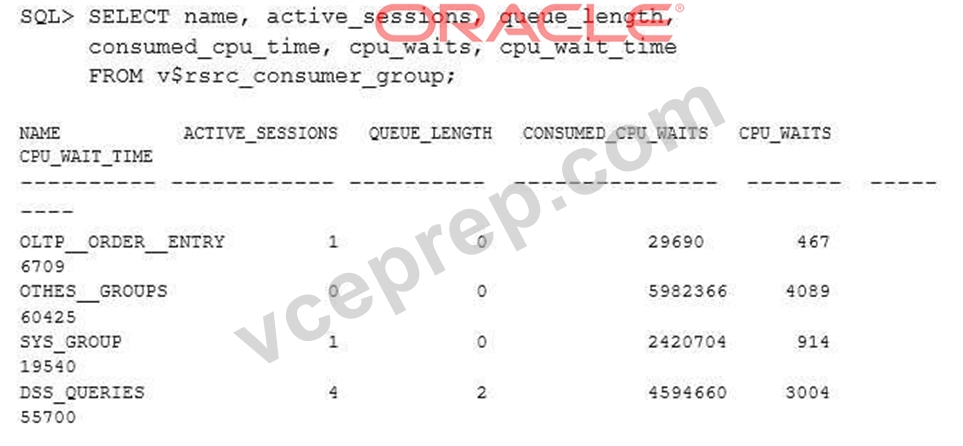
Which two statements are true? (Choose two.)
- A. A user belonging to the DSS__QUERIES resource consumer group can create a new session but the session will be queued.
- B. An attempt to start a new session by a user belonging to DSS_QUERIES fails with an error.
- C. An attempt to start a new session by a user belonging to OTHER_GROUPS fails with an error.
- D. The CPU_WAIT_TIME column indicates the total time that sessions in the consumer group waited for the CPU due to resource management.
- E. The CPU_WAIT_TIME column indicates the total time that sessions in the consumer group waited for the CPU due to I/O waits and latch or enqueue contention.
Answer: A,D
NEW QUESTION 180
Which statement is true about the Log Writer process?
- A. It writes when it receives a signal from the checkpoint process (CKPT).
- B. It writes concurrently to all members of multiplexed redo log groups.
- C. It writes when a user commits a transaction.
- D. It writes after the Database Writer process writes dirty buffers to disk.
Answer: C
Explanation:
Explanation
References:
http://docs.oracle.com/cd/B19306_01/server.102/b14220/process.htm
(see log writer process (LGWR))
NEW QUESTION 181
Which three statements are true about Oracle Data Pump? (Choose three.)
- A. A directory object must exist and a user performing an EXPDP or IMPDP operation must have read and write permission on that directory object.
- B. DBMS_DATAPUMP PL/SQL packages can be used independent of Data Pump clients.
- C. Oracle Data Pump export and import operations can be performed only by users with the SYSDBA privilege.
- D. Oracle Data Pump export and import operations can be performed to move data across different database releases.
- E. Oracle Data Pump export operations invoked from the clients that are connected remotely by using a connectionstring, create Data Pump files on the client file system.
Answer: A,B,D
NEW QUESTION 182
A database is stored in an Automatic Storage Management (ASM) disk group, disk group, DGROUP1 with SQL:
There is enough free space in the disk group for mirroring to be done.
What happens if the CONTROLLER1 failure group becomes unavailable due to error of for maintenance?
- A. Mirroring of allocation units will be done to ASM disks in the CONTROLLER2 failure group until the CONTROLLER1 for failure group is brought back online.
- B. Transactions accessing database objects contained in any tablespace stored in DGROUP1 will fail but queries will succeed.
- C. Transactions and queries accessing database objects contained in any tablespace stored in DGROUP1 will fall.
- D. The data in the CONTROLLER1 failure group is copied to the controller2 failure group and rebalancing is initiated.
- E. ASM does not mirror any data until the controller failure group is brought back online, and newly allocated primary allocation units (AU) are stored in the controller2 failure group, without mirroring.
Answer: E
NEW QUESTION 183
You upgraded from a previous Oracle database version to Oracle Database version to Oracle Database 12c. Your
database supports a mixed workload. During the day, lots of insert, update, and delete operations are performed. At
night, Extract, Transform, Load (ETL) and batch reporting jobs are run. The ETL jobs perform certain database
operations using two or more concurrent sessions.
After the upgrade, you notice that the performance of ETL jobs has degraded. To ascertain the cause of performance
degradation, you want to collect basic statistics such as the level of parallelism, total database time, and the number
of I/O requests for the ETL jobs.
How do you accomplish this?
- A. Examine the Active Session History (ASH) reports for the time period of the ETL or batch reporting runs.
- B. Enable SQL tracing for the queries in the ETL and batch reporting queries and gather diagnostic data from the trace
file. - C. Enable real-time SQL monitoring for ETL jobs and gather diagnostic data from the V$SQL_MONITOR view.
- D. Enable real-time database operation monitoring using the DBMS_SQL_MONITOR.BEGIN_OPERATION function, and
then use the DBMS_SQL_MONITOR.REPORT_SQL_MONITOR function to view the required information.
Answer: D
Explanation:
* Monitoring database operations
Real-Time Database Operations Monitoring enables you to monitor long running database tasks such as batch jobs,
scheduler jobs, and Extraction, Transformation, and Loading (ETL) jobs as a composite business operation. This feature
tracks the progress of SQL and PL/SQL queries associated with the business operation being monitored. As a DBA or
developer, you can define business operations for monitoring by explicitly specifying the start and end of the
operation or implicitly with tags that identify the operation.
NEW QUESTION 184
......
Top Oracle 1z0-062 Courses Online: https://testking.vceprep.com/1z0-062-latest-vce-prep.html