


[Nov 23, 2024] OGBA-101 Exam Dumps - The Open Group Practice Test Questions
New Real OGBA-101 Exam Dumps Questions
NEW QUESTION # 54
Which of the following is a benefit of information mapping?
- A. It highlights information requirements not addressed by a business architecture.
- B. It enables improved business process integration.
- C. It provides a basis to support decision-making throughout the business.
- D. It provides a framework for effective business requirements analysis.
Answer: C
Explanation:
One of the benefits of information mapping is that it provides a basis to support decision-making throughout the business1. Information mapping is a technique that can be used to document and visualize the information concepts and their relationships that are relevant for the business1. Information mapping can help to identify the information needs, sources, flows, quality, and value of the business, as well as the gaps, issues, and opportunities for improvement1. By providing a clear and consistent view of the information landscape, information mapping can enable better informed and more effective decisions at all levels of the business.
NEW QUESTION # 55
Complete the sentence. A business model is a description of the rationale for how an organization creates, delivers, and captures
- A. strategy
- B. value
- C. best practices
- D. business function
Answer: B
Explanation:
A business model is a description of the rationale for how an organization creates, delivers, and captures value4. Value is defined as the worth or importance of something to someone6. A business model explains what value proposition the organization offers to its customers, what revenue streams it generates from delivering the value proposition, what cost structure it incurs to create and deliver the value proposition, what key resources and activities are needed to create and deliver the value proposition, and what key partnerships are leveraged to support the value creation and delivery process4.
NEW QUESTION # 56
Which of the following is a benefit of developing a TOGAF business scenario?
- A. It provides general rules and guidelines to support planning at the enterprise level.
- B. It provides a versatile approach to business planning.
- C. It can be an important aid to vendors in delivering appropriate solutions.
- D. It provides an organizing framework for the change activity in a project.
Answer: C
Explanation:
Developing a TOGAF business scenario provides several benefits, particularly in aiding vendors to deliver appropriate solutions. Here's a detailed explanation:
* TOGAF Business Scenarios:
* Business scenarios are used to capture and describe business requirements, helping to identify and understand business needs and challenges.
* Role in Vendor Engagement:
* Clarity of Requirements: Business scenarios provide clear and detailed descriptions of the business context, needs, and requirements. This helps vendors understand what solutions are necessary to address specific business challenges.
* Alignment of Solutions: By providing a comprehensive view of the business environment and requirements, business scenarios ensure that the solutions proposed by vendors are aligned with the actual business needs and strategic goals.
* TOGAF ADM References:
* Phase A: Architecture Vision: In this phase, business scenarios are developed to capture stakeholder concerns and requirements, providing a basis for the architecture vision.
* Vendor Communication: Business scenarios are communicated to vendors to ensure that their solutions fit within the overall architecture and meet the specific requirements of the business.
* Benefits:
* Effective Solution Design: Vendors can design solutions that are tailored to the specific needs of the business, reducing the risk of misalignment and ensuring better outcomes.
* Improved Collaboration: Business scenarios facilitate better collaboration between the enterprise and vendors by providing a common understanding of the requirements and expected outcomes.
In summary, developing a TOGAF business scenario aids vendors in delivering appropriate solutions by providing clear and detailed descriptions of business requirements, ensuring alignment with business needs and strategic goals.
NEW QUESTION # 57
Which approach to model, measure, and analyze business value is primarily concerned with identifying the participants involved in creating and delivering value?
- A. Value streams
- B. Lean value streams
- C. Value chains
- D. Value networks
Answer: D
Explanation:
Value networks are an approach to model, measure, and analyze business value that is primarily concerned with identifying the participants involved in creating and delivering value3. Value networks focus on the relationships and interactions among the participants, such as customers, suppliers, partners, employees, and other stakeholders3. Value networks can help to understand how value flows through the network and how it can be improved or optimized.
NEW QUESTION # 58
In business capability mapping, when you have documented all of the business capabilities, what should you do next?
- A. Identify the human and computer actors associated with each business capability.
- B. Draw up a business value assessment for each of the business capabilities.
- C. Map the business capabilities to stakeholder concerns.
- D. Organize the business capabilities in a logical manner.
Answer: D
Explanation:
In business capability mapping, once all business capabilities have been documented, the next step is to organize these capabilities logically. This organization helps in understanding how different capabilities interact and align with the business strategy. Here's a detailed explanation based on TOGAF principles:
Business Capability Mapping:
Business capability mapping involves identifying and documenting the capabilities required to execute the business strategy. Capabilities are the building blocks of the business, representing what the business does.
Logical Organization:
Grouping and Categorization: Capabilities should be grouped and categorized logically to reflect their relationships and dependencies. This can be done by aligning capabilities with business functions, processes, or strategic objectives.
Hierarchical Structure: Organizing capabilities into a hierarchical structure helps in visualizing how high-level capabilities decompose into more specific, detailed capabilities. This hierarchical view aids in understanding the complexity and scope of capabilities.
Alignment with Strategy: Logical organization ensures that capabilities are aligned with the business strategy and objectives. It helps in identifying which capabilities are critical for achieving strategic goals and which ones need development or improvement.
TOGAF ADM References:
Phase B: Business Architecture: This phase involves developing the business architecture, including capability mapping. Organizing capabilities logically is a key step in this process, as it helps in creating a coherent and comprehensive business architecture.
Capability Models: TOGAF recommends using capability models to represent the organization's capabilities.
These models should be logically organized to facilitate analysis and planning.
Practical Steps:
Analyze Relationships: Examine the relationships between capabilities to identify dependencies and interactions. This analysis helps in grouping related capabilities together.
Create a Capability Map: Develop a visual representation of the capabilities, organized logically. This map serves as a reference for understanding the business architecture and planning initiatives.
In summary, after documenting all business capabilities, organizing them in a logical manner is essential for creating a coherent and effective business architecture. This logical organization facilitates better analysis, planning, and alignment with business strategy.
NEW QUESTION # 59
Which of the following describes how business models are used within the TOGAF standard?
- A. To help formulate architecture and business principles.
- B. To identify, classify, and mitigate risks to the business.
- C. To document the factors impacting the business migration plan.
- D. To tailor the enterprise architecture for the business.
Answer: D
Explanation:
Business models within the TOGAF standard are used to tailor the enterprise architecture to the specific needs and context of the business. They help in understanding how the business operates, its structure, and how it intends to achieve its goals, which is critical for ensuring that the enterprise architecture aligns with and supports the business objectives.
NEW QUESTION # 60
Consider the following modeling example, relating business capabilities to organization units so as to highlight duplication and redundancy: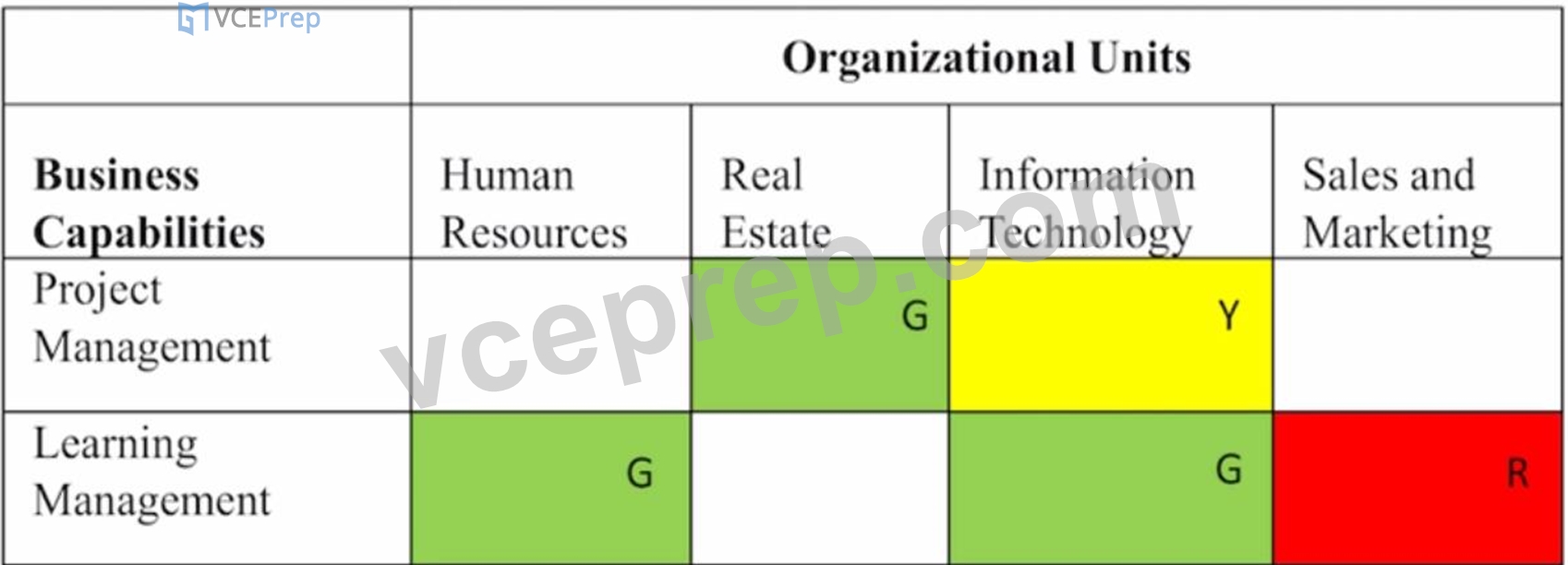
(Note in this example the cells colored green, yellow, and red, are also marked G. Y, and R, respectively) Which of the following best describes this technique?
- A. Perspective Analysis
- B. Gap Analysis
- C. Relationship Mapping
- D. Capability Mapping
Answer: C
Explanation:
The technique shown in the example is called relationship mapping. It is a technique that can be used to show how a business architecture addresses stakeholder concerns across different parts of an organization2. It can highlight gaps or overlaps in the coverage of stakeholder concerns by a business architecture. In this case, the technique is used to relate business capabilities to organization units so as to highlight duplication and redundancy.
NEW QUESTION # 61
Which of the following Business Architecture concepts should the architect examine and search for when developing the Architecture Vision?
- A. Architecture Continuum, Architecture Repository
- B. Value Streams, Business Capabilities
- C. Architecture Principles, Business Drivers
- D. Implementation Factor Catalog, Business Value Assessment Matrix
Answer: B
Explanation:
When developing the Architecture Vision, it is essential for the architect to examine and search for Value Streams and Business Capabilities. Here's a detailed explanation:
* Architecture Vision Phase (Phase A):
* The Architecture Vision phase sets the overall direction and context for the architecture project. It defines the scope and vision for the future state architecture and establishes a shared understanding among stakeholders.
* Value Streams:
* Definition: Value streams represent the end-to-end set of activities that deliver value to customers or stakeholders. They provide a high-level view of how value is created and delivered within the organization.
* Importance: Understanding value streams helps in aligning the architecture with business processes and ensuring that the architecture supports the delivery of value.
* Business Capabilities:
* Definition: Business capabilities define what an organization needs to be able to do to achieve its business objectives. They represent the core functions or abilities of the organization.
* Importance: Identifying and understanding business capabilities is crucial for ensuring that the architecture addresses the critical functions of the business and supports its strategic goals.
* TOGAF ADM References:
* Phase A: Architecture Vision: In this phase, the architect examines value streams and business capabilities to understand the current state and define the desired future state. This helps in creating an architecture vision that is aligned with business objectives and supports value creation.
* Strategic Planning: Value streams and business capabilities provide a foundation for strategic planning, ensuring that the architecture is designed to support key business activities and capabilities.
In summary, when developing the Architecture Vision, examining value streams and business capabilities is essential for understanding how the organization delivers value and ensuring that the architecture supports critical business functions and strategic objectives.
NEW QUESTION # 62
Which of the following is guidance for creating value streams?
- A. Include operational levels of detail.
- B. Start with customer-based value streams.
- C. Create an initial set of value streams that map one-to-one to existing capabilities.
- D. Identify the top-level value streams from components of capabilities.
Answer: B
Explanation:
One of the guidance for creating value streams is to start with customer-based value streams2. Customer-based value streams are those that describe how an enterprise creates and delivers value for its external customers2. Starting with customer-based value streams can help to ensure that the value streams are aligned with the customer needs and expectations, as well as the enterprise's value proposition and strategic objectives2. Customer-based value streams can also provide a foundation for identifying and defining other types of value streams, such as internal or partner-based value streams.
NEW QUESTION # 63
Which of the following is the element of a value stream stage that describes the state change that triggers the value stream stage?
- A. Gating stage
- B. Starting point
- C. Enhance criteria
- D. Baseline state
Answer: A
Explanation:
In the context of value stream stages, a gating stage is the element that describes the specific state change which triggers the next stage of the value stream to begin. It acts as a checkpoint that ensures that certain criteria are met before the process can proceed to the next phase.
NEW QUESTION # 64
Question: Which of the following best describes a business capability map?
- A. A self-contained view of the business that is independent of organizational structure, business processes, systems and applications.
- B. A reference model that provides a c onceptual definition of all the key building blocks within a business architecture
- C. The highest-level description of an organization, covering all missions and functions of the business.
- D. A holistic representation of capabilities, including end-to-end delivery value, and the relationships between these capabilities.
Answer: D
Explanation:
A business capability map is a comprehensive representation that showcases an organization's abilities in a structured manner. It identifies and illustrates the various business capabilities that allow the enterprise to function and deliver value. These capabilities are often defined independently of the organizational structure, processes, or technology, focusing instead on what the business does and can do. This map encompasses the end-to-end value delivery and how different capabilities interrelate and support one another, thus providing a holistic view of the business's functional abilities.
NEW QUESTION # 65
Which of the following best describes the relationship between business models and business architecture?
- A. Business models are useful for impact analysis, however Business Architecture is needed for scenario analysis.
- B. Business model development is a prerequisite for a Business Architecture development.
- C. Business Architecture provides a conceptual summary view, whereas business models support in-depth analysis.
- D. Business Architecture breaks a business model down into the core functional elements that describe how the business works.
Answer: D
Explanation:
A business model describes how an organization creates, delivers, and captures value for its stakeholders3. A business architecture breaks a business model down into the core functional elements that describe how the business works, such as the value proposition, the customer segments, the channels, the revenue streams, the cost structure, the key resources, the key activities, and the key partnerships3.
NEW QUESTION # 66
In what TOGAF ADM phase is the information map linked to other business blueprints?
- A. Preliminary Phase
- B. Phase E
- C. Phase A
- D. Phase B
Answer: B
Explanation:
Phase E Explanation of Correct answer: In Phase E (Opportunities and Solutions) of the TOGAF ADM, the information map is linked to other business blueprints such as the Business Capability Map, the Value Stream Map, and the Business Process Model2. This helps to identify and prioritize opportunities for business improvement and transformation2.
In the TOGAF Architecture Development Method (ADM), the information map is linked to other business blueprints during Phase B, Business Architecture. This phase involves the development of a business architecture to support an agreed Architecture Vision. It is during this phase that the information architecture is developed in detail, which involves mapping the information to the business, hence linking the information map to other business blueprints.
NEW QUESTION # 67
Which of the following best describes a business capability?
- A. It delineates what a business does without an explanation of how, why, or where the capability is used.
- B. It is a qualitative statement of intent that should be met by the enterprise architecture capability developing the business architecture.
- C. It is a detailed description of the architectural approach to realize a particular solution.
- D. It is an articulation of the relationships between business entities that make up the enterprise.
Answer: A
Explanation:
According to the TOGAF Series Guide to Business Capabilities (Version 2), a business capability is defined as "a particular ability or capacity that a business may possess or exchange to achieve a specific purpose or outcome" 4. A business capability delineates what a business does without an explanation of how, why, or where the capability is used4. A business capability can be expressed as a verb phrase that indicates what function or service the capability provides4. For example, some possible business capabilities are "Manage Customer Relationships", "Deliver Products", or "Perform Financial Analysis".
NEW QUESTION # 68
Which of the following is a benefit of information mapping?
- A. It highlights information requirements not addressed by a business architecture.
- B. It enables improved business process integration.
- C. It provides a basis to support decision-making throughout the business.
- D. It provides a framework for effective business requirements analysis.
Answer: A
NEW QUESTION # 69
Which of the following best describes a benefit of business models?
- A. They provide a different viewpoint to cross-check assumptions.
- B. They can be used to resolve conflicts amongst different stakeholders.
- C. They highlight what the business does without the need to explain why.
- D. They can be used to calculate detailed cost estimates.
Answer: A
Explanation:
Business models are essential tools within TOGAF for providing different perspectives on the business operations, strategies, and value propositions. Here's a detailed explanation:
* Purpose of Business Models:
* Business models are designed to represent various aspects of the business, such as value creation, delivery, and capture mechanisms. They provide a structured way to analyze and understand the business.
* Different Viewpoint:
* Cross-Check Assumptions: Business models offer a different viewpoint that helps in validating and cross-checking assumptions made about the business. By presenting a visual and structured representation of the business, these models enable stakeholders to identify gaps, inconsistencies, and areas that need further analysis.
* Holistic Understanding: They help in gaining a holistic understanding of how different components of the business interact, which is crucial for ensuring that the enterprise architecture aligns with the business strategy and goals.
* TOGAF References:
* Phase A: Architecture Vision: During this phase, business models are used to articulate the vision and scope of the architecture effort. They help in ensuring that all assumptions are validated and that the architecture aligns with business objectives.
* Phase B: Business Architecture: Business models are also utilized in this phase to analyze business capabilities, processes, and value streams. They provide a different viewpoint that aids in identifying areas for improvement and ensuring alignment with the strategic intent.
In summary, business models provide a different viewpoint that helps cross-check assumptions, ensuring that the enterprise architecture is aligned with the business strategy and objectives.
NEW QUESTION # 70
Which of the following is an analysis technique which is used to show a range of different perspectives on the same set of business capabilities?
- A. Information mapping
- B. Relationship mapping
- C. Heat mapping
- D. Capability decomposition
Answer: C
Explanation:
Heat mapping is an analysis technique used in TOGAF to show a range of different perspectives on the same set of business capabilities. This technique involves visually representing data to highlight areas of importance or concern, such as performance levels, resource allocation, or risk exposure. Heat maps provide a clear and intuitive way to identify strengths, weaknesses, opportunities, and threats within the business capabilities, facilitating better decision-making and prioritization of improvement efforts.
NEW QUESTION # 71
Which of the following is a benefit of organization mapping?
- A. An organization map improves the ability to consume, process, and deliver information.
- B. An organization map improves strategic planning.
- C. An organization map can be reused for training and employee development.
- D. An organization map highlights inefficiencies and reduces operational costs.
Answer: B
Explanation:
Organization mapping is a technique used to represent the structure and relationships within an organization.
Here's a detailed explanation of its benefits, particularly for strategic planning:
* Organization Mapping:
* Organization maps visually represent the hierarchical structure of an organization, including departments, teams, and reporting relationships. They provide insights into how the organization is structured and how different parts interact.
* Benefits for Strategic Planning:
* Alignment with Strategy: An organization map helps in aligning organizational structure with strategic goals. By understanding how the organization is structured, leaders can ensure that resources are allocated efficiently and that the organizational design supports the strategic objectives.
* Identifying Gaps and Overlaps: Organization maps highlight areas where there might be gaps or overlaps in roles and responsibilities. This information is crucial for making strategic decisions about restructuring or reallocating resources.
* Improving Communication: By clearly depicting the organizational structure, these maps improve communication and collaboration within the organization. This is particularly important for strategic planning, as it ensures that all parts of the organization are aligned and working towards the same goals.
* TOGAF References:
* Phase B: Business Architecture: Organization mapping is a key activity in this phase, where the current organizational structure is analyzed to ensure it supports the business strategy and architecture vision.
* Strategic Planning: TOGAF emphasizes the importance of aligning the business architecture with strategic planning. Organization maps are tools that facilitate this alignment by providing a clear representation of the organizational structure.
In summary, organization mapping improves strategic planning by providing a clear, visual representation of the organizational structure, helping to align resources and design with strategic goals.
NEW QUESTION # 72
Which approach to modeling business value is designed to create and end-to-end perspective of value from the customer's perspective?
- A. Value streams
- B. Lean value streams
- C. Value chains
- D. Value networks
Answer: A
Explanation:
A value stream is an approach to modeling business value that focuses on the end-to-end sequence of activities that an organization performs to deliver a product or service to the customer. This perspective is designed to help organizations understand the full lifecycle of value creation, from the initial customer demand to the final delivery of value. It provides a holistic view of the flow of value through the organization and is instrumental in identifying areas of waste and opportunities for improvement to enhance the overall customer experience.
Value streams help in visualizing and optimizing the steps necessary to effect change in the business processes and systems that create value for the customers.
NEW QUESTION # 73
Complete the sentence. The TOGAF standard covers the development of four architecture domains. Business. Dat a. Technology and___________.
- A. Application
- B. Segment
- C. Transition
- D. Capability
Answer: A
Explanation:
The TOGAF standard covers the development of four architecture domains: Business, Data, Technology, and Application. The Application Architecture domain defines the applications required to process the data and support the business functions.
NEW QUESTION # 74
Explain how business models can be used according to the TOGAF standard.
- A. To plan the Implementation activities for the architecture project.
- B. To define a taxonomy of services needed to support the change
- C. To identify new capabilities required to realize the target business model.
- D. To estimate resource requirements for the definition of the architecture.
Answer: C
Explanation:
According to the TOGAF standard, business models are used to understand and describe the business itself, including its organization, its objectives, and how it operates. This understanding is crucial when defining an enterprise architecture as it provides a frame of reference. Business models help in identifying new capabilities that the business must develop to achieve its future state as outlined in the target business model. These capabilities may be processes, information, or technologies that the business must adopt or adapt to fulfill the strategic objectives and deliver value. TOGAF emphasizes the alignment of IT with business strategy, and the business model serves as a key link in ensuring that the capabilities delivered by the enterprise architecture will enable the desired business outcomes.
NEW QUESTION # 75
......
Pass Your OGBA-101 Exam Easily with Accurate PDF Questions: https://testking.vceprep.com/OGBA-101-latest-vce-prep.html